Parallel processing guide — Casey 2019 Common Ground ABZ calls
Demonstrates how to characterise a large dataset, measure parpool startup overhead, identify CPU vs I/O bottlenecks, and choose parallel settings before committing to a full batch run.
Uses the Casey 2019 Common Ground capture history (Miller et al., in press) as the worked example — adjudicated ABZ-call detections from three analyst observers and two automated detectors, across ~200 h of continuous recording. The five-observer × 10k-row workload (~50k annotation measurements) is large enough to make the parallel tradeoffs concrete and informative.
WHAT THIS GUIDE COVERS 1. Dataset characterisation 2. Pool startup cost — the tradeoff behind parallelThreshold 3. Serial baseline — time trim+SNR, extrapolate to full workload 4. Worker sweep + break-even N — measured parallel rate, lowest absolute wall time, CPU vs I/O diagnosis, speedup plot 5. Full batch — trim+SNR per observer + merged union
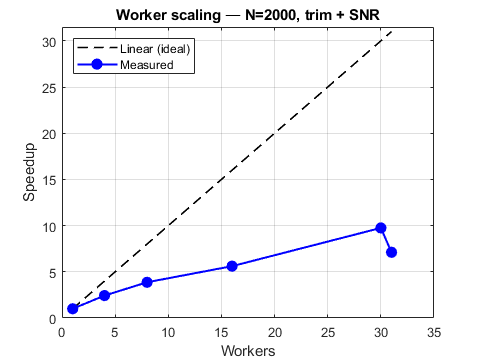
INTERPRETING THE SPEEDUP CURVE Near-linear speedup → CPU bound. More workers give proportional gains. Speedup plateaus below nWorkers → I/O bound. Disk throughput is the bottleneck. More workers will not help. Consider co-locating audio and compute on the same machine, or using an SSD.
The saved results CSV can be used for downstream analysis — see companion notes on SNR as a discriminator of true vs false positives (Miller et al., in preparation).
REFERENCE Miller, B.S. et al. (in press). Common ground: efficient, consistent, observer-independent bioacoustic call density estimation with adjudicated ground truth and capture-recapture detection functions. Methods in Ecology and Evolution.
DATA Capture history: included in examples/ (this script's directory) Recordings: Australian Antarctic Data Centre (submission pending) https://data.aad.gov.au/metadata/AAS_4102_longTermAcousticRecordings
Contents
User configuration
wavRoot = 'w:\annotatedLibrary\BAFAAL\Casey2019\wav';

captureHistoryFile = fullfile(fileparts(mfilename('fullpath')), ...
    'MultiObserverCaptureHistory_Casey2019_Bm-Ant-ABZ-calls_analysts123sd_judgedBSM_simpleSnr.csv');

sampleSize  = 500;   % annotations for serial baseline (reliable extrapolation)
sweepSize   = 2000;  % annotations for worker sweep (near break-even, ~67 per worker at 30)
SNR and trim parameters — fixed [25 29] Hz band for all observers
snrP               = struct();
snrP.snrType       = 'spectrogramSlices';
snrP.useLurton     = false;
snrP.noiseLocation = 'beforeAndAfter';
snrP.noiseDelay    = 1;
snrP.nfft          = 1024;
snrP.nOverlap      = floor(1024 * 0.75);
snrP.freq          = [25 29];
snrP.showClips     = false;

trimP = {'freq', [25 29], 'nfft', 1024, 'showPlot', false};

obsNames = {'Analyst 1','Analyst 2','Analyst 3','Detector 4','Detector 5'};
obsKeys  = {'obs1','obs2','obs3','obs4','obs5','merged'};
obsLabels = [obsNames, {'Merged'}];

%%%%%%%%%%%%%%%%%%%%%%%%%%%%%%%%%%%%%%%%%%%%%%%%%%%%%%%%%%%%%%%%%%%%%%%%%%%
1. Dataset characterisation
%%%%%%%%%%%%%%%%%%%%%%%%%%%%%%%%%%%%%%%%%%%%%%%%%%%%%%%%%%%%%%%%%%%%%%%%%%%

fprintf('=== Parallel Processing Guide — Casey 2019 ABZ calls ===\n\n');
fprintf('--- 1. Dataset characterisation ---\n');

ch    = readtable(captureHistoryFile, 'VariableNamingRule', 'preserve');
nRows = height(ch);

fprintf('  Total rows (all observers):  %d\n', nRows);
fprintf('  Judged rows:                 %d  (true: %d  false: %d)\n', ...
    sum(logical(ch.judged)), ...
    sum(logical(ch.judged) & ch.verdict == 1), ...
    sum(logical(ch.judged) & ch.verdict == 0));

detCols = {'detect_observer1','detect_observer2','detect_observer3', ...
           'detect_observer4','detect_observer5'};
for obs = 1:5
    nDet = sum(logical(ch.(detCols{obs})));
    fprintf('  Observer %d (%s): %d detections\n', obs, obsNames{obs}, nDet);
end

anyDet = any(ch{:, detCols} == 1, 2);
fprintf('  Union (any observer):        %d detections\n\n', sum(anyDet));

%%%%%%%%%%%%%%%%%%%%%%%%%%%%%%%%%%%%%%%%%%%%%%%%%%%%%%%%%%%%%%%%%%%%%%%%%%%
=== Parallel Processing Guide — Casey 2019 ABZ calls ===

--- 1. Dataset characterisation ---
  Total rows (all observers):  10312
  Judged rows:                 1289  (true: 681  false: 608)
  Observer 1 (Analyst 1): 3166 detections
  Observer 2 (Analyst 2): 7048 detections
  Observer 3 (Analyst 3): 9273 detections
  Observer 4 (Detector 4): 2289 detections
  Observer 5 (Detector 5): 3821 detections
  Union (any observer):        10312 detections
2. Pool startup cost
%%%%%%%%%%%%%%%%%%%%%%%%%%%%%%%%%%%%%%%%%%%%%%%%%%%%%%%%%%%%%%%%%%%%%%%%%%%

fprintf('--- 2. Pool startup cost ---\n');

hasParallel = ~isempty(ver('parallel'));
if ~hasParallel
    fprintf('  Parallel Computing Toolbox not available.\n\n');
    tStartup   = 0;
    maxWorkers = 1;
else
    maxWorkers = max(1, feature('numcores') - 1);   % leave one core free
    pool = gcp('nocreate');
    if ~isempty(pool), evalc('delete(pool)'); end

    tPool    = tic;
    evalc('parpool(''Processes'', maxWorkers)');
    tStartup = toc(tPool);

    fprintf('  parpool startup (%d workers): %.1f s\n', maxWorkers, tStartup);
    fprintf('  This fixed overhead must be recovered by parallel speedup.\n\n');
end

%%%%%%%%%%%%%%%%%%%%%%%%%%%%%%%%%%%%%%%%%%%%%%%%%%%%%%%%%%%%%%%%%%%%%%%%%%%
--- 2. Pool startup cost ---
  parpool startup (31 workers): 18.0 s
  This fixed overhead must be recovered by parallel speedup.
3. Serial baseline — trim + SNR on a small sample
%%%%%%%%%%%%%%%%%%%%%%%%%%%%%%%%%%%%%%%%%%%%%%%%%%%%%%%%%%%%%%%%%%%%%%%%%%%

fprintf('--- 3. Serial baseline (N=%d, trim + SNR) ---\n', sampleSize);

% Build observer 1 annotations
mask1 = logical(ch.detect_observer1);
annotObs1 = table();
annotObs1.soundFolder   = repmat({wavRoot}, sum(mask1), 1);
annotObs1.t0            = ch.t0_observer1(mask1);
annotObs1.tEnd          = ch.tEnd_observer1(mask1);
annotObs1.duration      = ch.duration_observer1(mask1);
annotObs1.freq          = repmat([25 29], sum(mask1), 1);
annotObs1.channel       = ones(sum(mask1), 1);
annotObs1.rowIdx        = find(mask1);

sample = annotObs1(1:min(sampleSize, height(annotObs1)), :);

% Force serial by setting parallelThreshold above sampleSize
snrPserial = snrP; snrPserial.parallelThreshold = sampleSize + 1;

tS = tic;
evalc("sampleTrimmed = trimAnnotation(sample, trimP{:}, 'parallelThreshold', sampleSize+1); snrEstimate(sampleTrimmed, snrPserial);");
tSerial = toc(tS);

tPerAnnot = tSerial / height(sample);

% Total workload across all observers + merged
totalAnnots = sum(cellfun(@(c) sum(logical(ch.(c))), detCols)) + sum(anyDet);
tEstimatedMin = tPerAnnot * totalAnnots / 60;

fprintf('  %d annotations in %.1f s → %.3f s/annotation\n', ...
    height(sample), tSerial, tPerAnnot);
fprintf('  Total workload (~%d annotations): estimated %.1f min serial\n\n', ...
    totalAnnots, tEstimatedMin);

%%%%%%%%%%%%%%%%%%%%%%%%%%%%%%%%%%%%%%%%%%%%%%%%%%%%%%%%%%%%%%%%%%%%%%%%%%%
pThresh   = 100;   % default; updated after worker sweep with measured rates
breakEven = nan;   % computed from measured parallel rate after sweep

%%%%%%%%%%%%%%%%%%%%%%%%%%%%%%%%%%%%%%%%%%%%%%%%%%%%%%%%%%%%%%%%%%%%%%%%%%%
--- 3. Serial baseline (N=500, trim + SNR) ---
  500 annotations in 2.6 s → 0.005 s/annotation
  Total workload (~35909 annotations): estimated 3.1 min serial
5. Worker sweep at fixed N
%%%%%%%%%%%%%%%%%%%%%%%%%%%%%%%%%%%%%%%%%%%%%%%%%%%%%%%%%%%%%%%%%%%%%%%%%%%

fprintf('--- 4. Worker sweep (N=%d) and break-even N ---\n', sweepSize);

if ~hasParallel
    fprintf('  Parallel Computing Toolbox not available — skipping.\n\n');
    nWorkersList = 1;
    tByWorkers   = tSerial * sweepSize / sampleSize;  % scale estimate
    optWorkers   = 1;
else
    sweep = annotObs1(1:min(sweepSize, height(annotObs1)), :);
    nWorkersList = unique([1, 4, 8, 16, 30, maxWorkers]);
    nWorkersList = nWorkersList(nWorkersList <= maxWorkers);
    tByWorkers   = nan(size(nWorkersList));

    fprintf('  %-8s  %-10s  %-8s  %s\n', 'Workers', 'Time (s)', 'Speedup', 'Diagnosis');
    fprintf('  %s\n', repmat('-', 1, 55));

    tW1 = nan;
    snrPpar = snrP; snrPpar.parallelThreshold = 1;
    for ki = 1:numel(nWorkersList)
        nW   = nWorkersList(ki);
        pool = gcp('nocreate');
        if ~isempty(pool) && pool.NumWorkers ~= nW, evalc('delete(pool)'); end
        if isempty(gcp('nocreate')), evalc('parpool(''Processes'', nW)'); end

        tw = tic;
        evalc("sTrim = trimAnnotation(sweep, trimP{:}, 'parallelThreshold', 1); snrEstimate(sTrim, snrPpar);");
        tByWorkers(ki) = toc(tw);

        if nW == 1, tW1 = tByWorkers(ki); end
        speedup = tW1 / tByWorkers(ki);

        if     nW == 1,              diagnosis = 'baseline';
        elseif speedup >= 0.7 * nW,  diagnosis = 'CPU bound — good scaling';
        elseif speedup >= 0.4 * nW,  diagnosis = 'mixed CPU / I/O';
        else,                         diagnosis = 'I/O bound — disk bottleneck';
        end

        fprintf('  %-8d  %-10.1f  %-8.1fx  %s\n', nW, tByWorkers(ki), speedup, diagnosis);
    end
    fprintf('\n');

    % Speedup plot
    speedups = tW1 ./ tByWorkers;
    figure('Name', 'Worker scaling', 'Units', 'pixels', 'Position', [100 100 480 360]);
    hold on;
    plot(nWorkersList, nWorkersList, 'k--', 'LineWidth', 1.2, 'DisplayName', 'Linear (ideal)');
    plot(nWorkersList, speedups, 'b-o', 'LineWidth', 1.5, ...
        'MarkerSize', 7, 'MarkerFaceColor', 'b', 'DisplayName', 'Measured');
    hold off;
    xlabel('Workers'); ylabel('Speedup');
    title(sprintf('Worker scaling — N=%d, trim + SNR', sweepSize));
    legend('Location', 'northwest'); grid on; box on;
    ylim([0, max(nWorkersList) + 0.5]);

    % Optimal workers: lowest absolute wall time
    % (for large workloads absolute speed matters more than efficiency)
    [~, bestIdx] = min(tByWorkers);
    optWorkers   = nWorkersList(bestIdx);
    fprintf('  Recommended workers: %d (lowest wall time = %.1f s)\n', ...
        optWorkers, tByWorkers(bestIdx));
    if tByWorkers(end) < tByWorkers(bestIdx) * 1.05
        fprintf('  Note: %d workers gives similar time — diminishing returns\n', ...
            nWorkersList(end));
    end

    % Break-even using measured parallel rate (more reliable than estimated)
    tParAnnot = tByWorkers(bestIdx) / sweepSize;   % measured s/annotation in parallel
    if tPerAnnot > tParAnnot
        breakEven = ceil(tStartup / (tPerAnnot - tParAnnot));
        pThresh   = max(breakEven, 10);
        fprintf('  Break-even N:        ~%d annotations\n', breakEven);
        fprintf('    (startup %.1f s / saving %.3f s/annotation)\n', ...
            tStartup, tPerAnnot - tParAnnot);
    else
        breakEven = Inf;
        fprintf('  Break-even: N/A — parallel not faster at sweep size\n');
    end
    fprintf('  Recommended parallelThreshold: %d\n\n', pThresh);
end

%%%%%%%%%%%%%%%%%%%%%%%%%%%%%%%%%%%%%%%%%%%%%%%%%%%%%%%%%%%%%%%%%%%%%%%%%%%
--- 4. Worker sweep (N=2000) and break-even N ---
  Workers   Time (s)    Speedup   Diagnosis
  -------------------------------------------------------
  1         51.1        1.0     x  baseline
  4         21.0        2.4     x  mixed CPU / I/O
  8         13.2        3.9     x  mixed CPU / I/O
  16        9.1         5.6     x  I/O bound — disk bottleneck
  30        5.2         9.8     x  I/O bound — disk bottleneck
  31        7.2         7.1     x  I/O bound — disk bottleneck

  Recommended workers: 30 (lowest wall time = 5.2 s)
  Break-even N:        ~6911 annotations
    (startup 18.0 s / saving 0.003 s/annotation)
  Recommended parallelThreshold: 6911
6. Full batch — trim + SNR per observer + merged
%%%%%%%%%%%%%%%%%%%%%%%%%%%%%%%%%%%%%%%%%%%%%%%%%%%%%%%%%%%%%%%%%%%%%%%%%%%

fprintf('--- 5. Full batch run ---\n');
fprintf('  (Progress indicators from snrEstimate are expected for large batches)\n');

if hasParallel
    pool = gcp('nocreate');
    if ~isempty(pool) && pool.NumWorkers ~= optWorkers, evalc('delete(pool)'); end
    if isempty(gcp('nocreate')), evalc('parpool(''Processes'', optWorkers)'); end
end

snrPbatch = snrP; snrPbatch.parallelThreshold = pThresh;
snrResults = struct();
tFull = tic;

for obs = 1:5
    fprintf('  Observer %d (%s)...', obs, obsNames{obs});
    detCol_ = sprintf('detect_observer%d',   obs);
    t0Col_  = sprintf('t0_observer%d',       obs);
    tEnd_   = sprintf('tEnd_observer%d',     obs);
    dur_    = sprintf('duration_observer%d', obs);
    mask_   = logical(ch.(detCol_));
    n_      = sum(mask_);

    aObs               = table();
    aObs.soundFolder   = repmat({wavRoot}, n_, 1);
    aObs.t0            = ch.(t0Col_)(mask_);
    aObs.tEnd          = ch.(tEnd_)(mask_);
    aObs.duration      = ch.(dur_)(mask_);
    aObs.freq          = repmat([25 29], n_, 1);
    aObs.channel       = ones(n_, 1);
    aObs.rowIdx        = find(mask_);

    evalc("aTrim = trimAnnotation(aObs, trimP{:}, 'parallelThreshold', pThresh);");
    evalc('res = snrEstimate(aTrim, snrPbatch);');

    snrResults.(sprintf('obs%d', obs)).annots  = aObs;
    snrResults.(sprintf('obs%d', obs)).trimmed = aTrim;
    snrResults.(sprintf('obs%d', obs)).result  = res;
    fprintf(' %d annotations, median SNR = %.1f dB\n', height(res), median(res.snr,'omitnan'));
end

% Merged: union of all positive detections
fprintf('  Merged (union of all positives)...');
nMerge               = sum(anyDet);
aMerge               = table();
aMerge.soundFolder   = repmat({wavRoot}, nMerge, 1);
aMerge.t0            = ch.t0(anyDet);
aMerge.tEnd          = ch.tEnd(anyDet);
aMerge.duration      = (ch.tEnd(anyDet) - ch.t0(anyDet)) * 86400;
aMerge.freq          = repmat([25 29], nMerge, 1);
aMerge.channel       = ones(nMerge, 1);
aMerge.rowIdx        = find(anyDet);

evalc("aMergeTrim = trimAnnotation(aMerge, trimP{:}, 'parallelThreshold', pThresh);");
evalc('resMerge = snrEstimate(aMergeTrim, snrPbatch);');
snrResults.merged.annots  = aMerge;
snrResults.merged.trimmed = aMergeTrim;
snrResults.merged.result  = resMerge;
fprintf(' %d annotations, median SNR = %.1f dB\n', height(resMerge), ...
    median(resMerge.snr,'omitnan'));

tTotal = toc(tFull);
fprintf('\n  Total wall time: %.1f min (%.2f s/annotation equivalent)\n', ...
    tTotal/60, tTotal/totalAnnots);
fprintf('  Actual speedup vs serial estimate: %.1fx\n\n', ...
    tEstimatedMin*60 / tTotal);
--- 5. Full batch run ---
  (Progress indicators from snrEstimate are expected for large batches)
  Observer 1 (Analyst 1)... 3166 annotations, median SNR = 3.8 dB
  Observer 2 (Analyst 2)... 7048 annotations, median SNR = 1.9 dB
  Observer 3 (Analyst 3)... 9273 annotations, median SNR = 2.4 dB
  Observer 4 (Detector 4)... 2289 annotations, median SNR = 3.5 dB
  Observer 5 (Detector 5)... 3821 annotations, median SNR = 2.5 dB
  Merged (union of all positives)... 10312 annotations, median SNR = 1.9 dB

  Total wall time: 1.4 min (0.00 s/annotation equivalent)
  Actual speedup vs serial estimate: 2.2x
Save results for downstream analysis
outFile = fullfile(fileparts(mfilename('fullpath')), ...
    'snr_parallel_guide_casey2019_results.csv');

allRows = table();
for k = 1:5
    key            = obsKeys{k};
    r              = snrResults.(key).result;
    r.observer     = repmat(k, height(r), 1);
    r.rowIdx       = snrResults.(key).annots.rowIdx;
    allRows        = [allRows; r(:, {'observer','rowIdx','snr','signalRMSdB','noiseRMSdB'})]; %#ok<AGROW>
end
writetable(allRows, outFile);
fprintf('\nResults saved to: %s\n', outFile);
fprintf('Load with: results = readtable(''%s'');\n', outFile);
Results saved to: C:\analysis\bsnr\examples\snr_parallel_guide_casey2019_results.csv
Load with: results = readtable('C:\analysis\bsnr\examples\snr_parallel_guide_casey2019_results.csv');